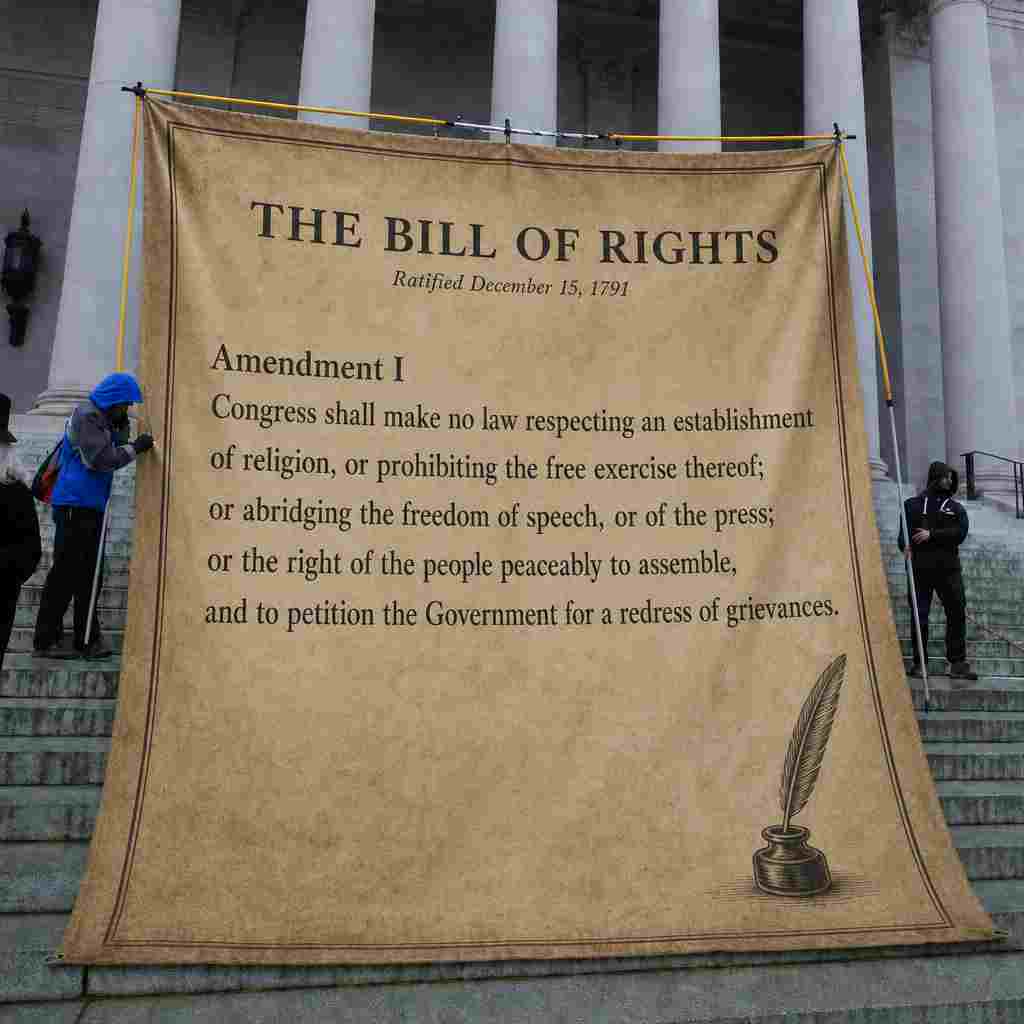
Last night I attended a Side With Love forum which featured a panel discussing our democracy, specifically what we are celebrating on the 250th anniversary of our country. Side With Love is sponsored by our national Unitarian Universalist Association (UUA), and the panel featured our UUA President, Sofia Betancourt. I spent much of the hour thinking about recent action by the Department of Defense that reduced allowable religious tradition choices from over 180 to 31, 22 of which are Christian. Many of our Founding Fathers would be appalled.
The freedom of religion that the founders of this nation created was not only for people who shared their beliefs. The First Amendment is based on the idea that the government should not decide which religious faiths are legitimate and which should be excluded. Deists, Unitarians, Jews, Catholics, Baptists, Quakers, and many others could exist and flourish side by side without the government deciding if their beliefs were American enough.
Some of the most famous founders did not fit neatly into religious categories. Benjamin Franklin publicly questioned Christian traditions. Some of the signers of the Declaration of Independence were Deists, who believed in a God who created the universe but did not manifest in daily life or in organized religion. Thomas Jefferson did not believe in the divinity of Jesus. John Adams attended a Unitarian, not a Trinitarian church.
There is a juxtaposition of the First Amendment and the Department of Defense. Prior to last week’s announcement, the Department of Defense allowed service members to choose from over 180 different faith groups to be noted in their personnel records. (They are still able to keep their actual affiliation on their personal ID, often known as “dog tags.”) Among several Christian traditions, choices of Ba’hai, Buddhist, Agnostic, Hindu, Muslim, Jewish, Sikh and a few others remain. Paganism, Unitarian Universalism, and Humanism were omitted. Mormon Latter-Day Saints were set apart from other Christian faiths. Even the United Church of Christ is now characterized as “Christian – other.”
The explanation given by the Department of Defense was that simplification would allow the Chaplain to quickly assess the religious composition of their units and determine how to structure resources “to best provide for war fighters of all faith groups.” As a minister, this explanation makes no sense to me. I would only be able to look at a small slice of the faiths represented and then have to guess at the others. This would certainly not be providing for “all faith groups” – only the groups that the DOD has found to matter.
June 8th was the anniversary of James Madison’s standing before the House of Representatives in 1789 to introduce a set of amendments that later became the Bill of Rights. The first freedom was religious freedom. I remain thankful that I can choose my own religion, or none, and that so far, I have the freedom to seek my own spiritual truths. I remember each day that our Unitarian Universalist faith calls us all to believe that all expressions of faith matter. May it always be so. |